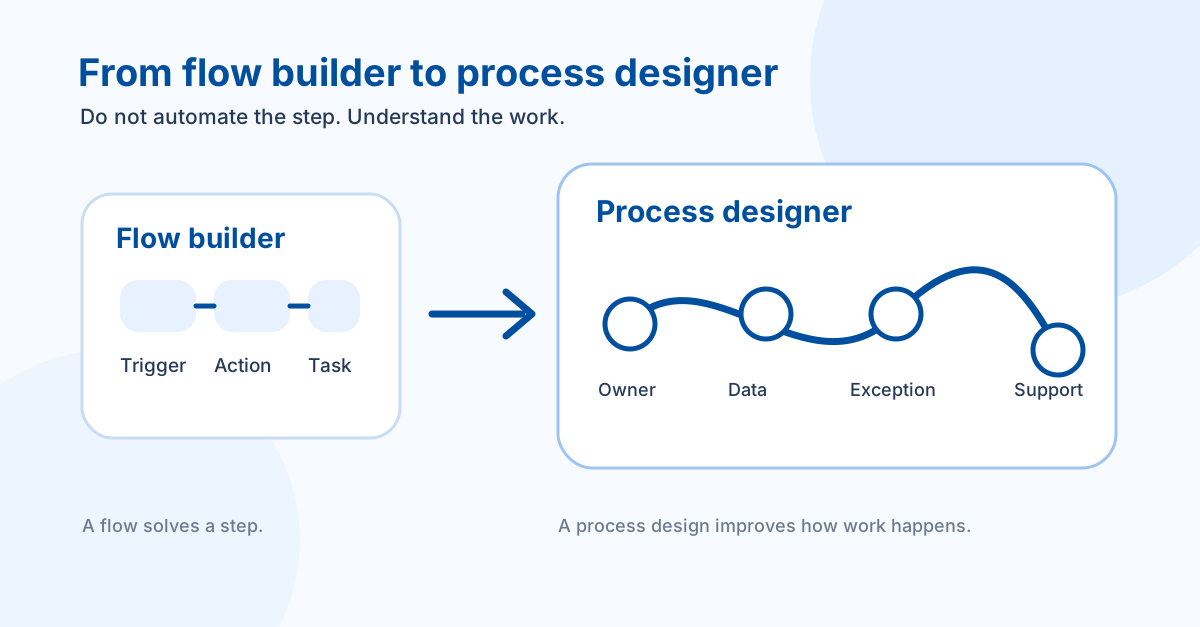
The best Power Platform makers do not just automate tasks. They understand how work moves through an organisation. That sounds simple, but it is probably the difference between a useful flow and a solution the business can actually rely on.
The Maker Mindset Is Evolving
Power Automate made automation accessible. That was a huge step forward. Suddenly, business users could connect systems, move data, send approvals and remove repetitive work without waiting months for a traditional development cycle. That democratisation was real, and it still matters.
But there is a risk. When people only think in triggers and actions, they can miss the bigger picture.
A flow is not a process. It is one implementation of part of a process.
Automating a Step Is Not Enough
In Stop Adding AI to Broken Processes I argued that AI amplifies whatever process sits underneath it. The same is true for classic automation.
A common pattern is to take a manual step and automate it exactly as it exists today:
- Someone sends an email, so we automate the email.
- Someone updates a spreadsheet, so we automate the update.
- Someone asks for approval, so we create an approval flow.
That can help. It can also preserve old habits. The stronger move is to ask why the step exists in the first place:
- Is the approval still needed?
- Is the spreadsheet the right source?
- Should the process start earlier?
- Should an exception go to a different team?
Those questions matter because automation is not neutral. It reinforces the process design behind it.
The New Skill: Process Thinking
Future makers need to become process designers. That means understanding handovers, exceptions, ownership, data quality, security, support and lifecycle. It means looking at the whole journey, not only the step that hurts today.
This is where Power Platform becomes powerful. Apps, flows, Dataverse, Power BI, Copilot Studio and agents can all support one process from different angles. The value is not in the individual component. The value is in how the components work together.
From Builder to Designer
The best makers already do this naturally. They ask better questions before they build:
- Who owns the outcome?
- What happens when something fails?
- Which data is trusted?
- Who supports this in production?
- What should be automated, and what should stay human?
That is the difference between building a flow and designing a process. One solves a task. The other improves the way work happens.
Why spend your best people on avoidable friction when they could focus on the work that actually needs judgement?
The future Power Platform maker is not only a flow builder. The future maker is a process designer.