What comes to mind when you think about AI? Most people picture a chat window, an interface where you type a question and get an instant response.
That’s understandable. We think in conversations. We communicate through language. And for many of us, ChatGPT was our first real encounter with AI. The chat interface felt natural, accessible, powerful.
But by viewing AI primarily as a chat tool, we’re missing most of its potential. And more importantly, we’re setting ourselves up for disappointment when we try to deploy it at scale.
AI Is Everywhere (Without Chat)
Here’s what most people don’t notice: AI is deeply embedded in technology you use every day, almost always without a chat interface.
Your smartphone adjusts photos in poor lighting using AI. You unlock your phone with facial recognition or fingerprint analysis, both AI. Google Translate lets you photograph text and instantly see it translated. These all use machine learning, yet we rarely call them “AI.”
For years, companies have used OCR (Optical Character Recognition) to read and interpret documents. It works reliably, at scale, completely invisibly. No one needs to ask it questions.
The pattern is clear: Most of AI’s value has never been conversational.
Why We Confuse AI With Chat
Chat brought AI out of the background and made it visible. For the first time, AI felt like something you could directly interact with, not just something that happened behind the scenes.
That visibility had a cost: it narrowed how we think about AI.
The moment someone says “AI,” most people’s minds immediately go to ChatGPT or similar tools. Chat feels familiar, no training required, just ask a question. That accessibility is powerful for exploration and learning.
But accessibility isn’t the same as scalability. And that’s where the real problems begin.
Why Chat-Based AI Doesn’t Scale
Here’s the fundamental issue: if every AI action requires explicit human input through a chat interface, you’ve created a bottleneck.
Each decision requires someone to ask the right question at the right time. That’s great for ad-hoc exploration. It’s terrible for systematic process improvement.
Think about how companies design their processes: standardised workflows, predictable paths, minimal manual intervention. Now imagine forcing every AI action to depend on someone having a conversation. It’s contradictory.
If you want AI to genuinely transform your operations, you can’t rely on chat. You need AI that acts proactively, independently, within defined boundaries.
From Chat to Autonomous Agents
This is where autonomous agents come in.
Rather than having AI respond to explicit human questions, agents monitor your processes. They communicate with other systems. They work toward outcomes without constant human intervention (unless you define it that way).
Where chat supports one-to-one interaction, agents enable scalable collaboration. You’re not creating a single personal assistant, you’re building a network of digital colleagues, each with a clearly defined role.
This doesn’t require revolutionary new technology. It requires a different mental model.
A Concrete Example: Lead-to-Opportunity
Consider the classic CRM lead-to-opportunity pipeline. It’s a proven process that helps teams collaborate efficiently.
Using chat-based AI (one layer of value):
- “Which leads came in today?” → immediate summary
- “Create a recap of my meeting with Company X” → done in seconds
- “Are these leads qualified?” → AI provides assessment
These are useful, but they’re still one-to-one interactions. Someone had to ask the right question.
Using AI agents (exponentially more value):
- Agents continuously collect signals about incoming leads (company research, job changes, intent data)
- After a conversation, agents automatically extract action items and evaluate match-to-strategy
- Agents flag priority opportunities based on context and customer sentiment
- Qualification happens autonomously, while humans focus on relationship-building and closing
At that point, you’ve fundamentally redesigned the process. You’re not just speeding up an existing workflow, you’re building a smarter one.
The Invisible Impact
When AI operates in the background, something shifts. Humans move from tactical data entry and qualification to strategic work: relationship management, decision-making, creative problem-solving.
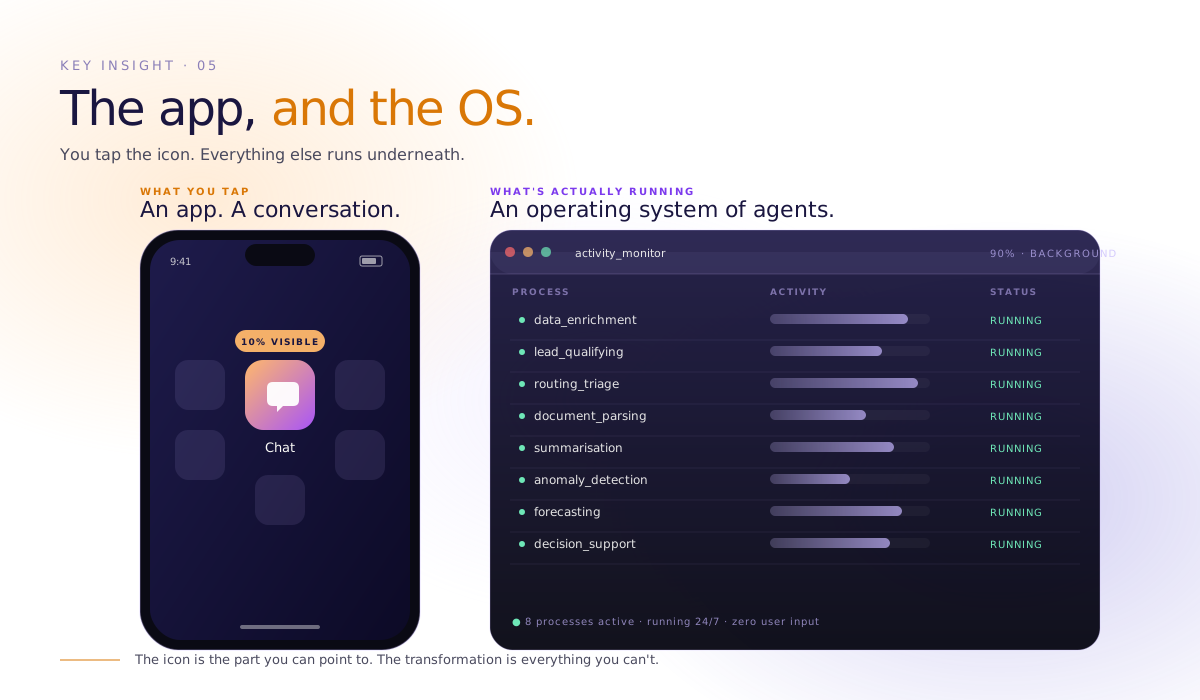
Chat still has a role. It’s useful, visible, familiar. But it’s only the visible 10% of AI’s impact.
Around 90% of AI’s value operates quietly, autonomously, behind the scenes. That’s where the real transformation happens.
The Lesson: Start With Processes, Not Chat
Most organisations begin their AI journey with experimentation, chat interfaces, quick pilots, visible wins. That’s fine for exploration.
But if you stop there, you’ve missed the point.
The strategic question isn’t “How can we add a chatbot to our operations?” It’s “Which processes would fundamentally improve if AI handled the routine decisions, escalated exceptions, and freed humans to focus on judgment calls?”
When you start from that question, you shift from adding AI to a process to redesigning the process around AI.
Chat feels familiar. Processes feel boring. But processes are where real impact lives.
Don’t start with conversations. Start with processes. That’s where AI’s true power emerges.
Originally published on Cegeka’s blog.